Super Intelligence Must Be Measured by Mission Outcomes
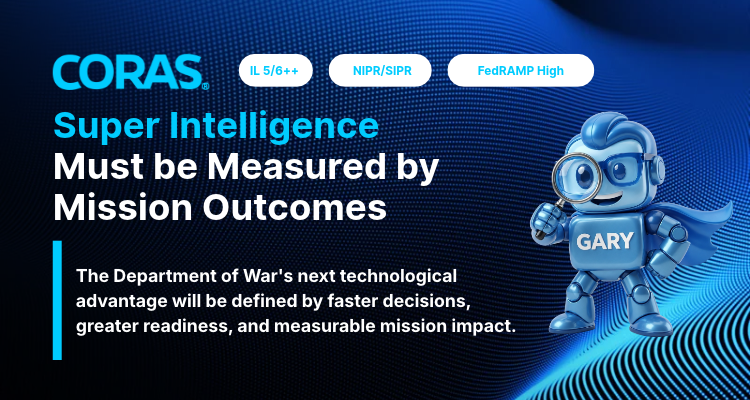

The Department of War's next technological advantage will be defined by faster decisions, greater readiness, and measurable mission impact.
The DOW's transition from Artificial Intelligence to Super Intelligence signals a new chapter in defense technology. In his November 18, 2026, Military Times article, “What AI’s rebrand to ‘super intelligence’ means for the Pentagon,” Daniel Terrill examines the redesignation of the Pentagon's Chief Digital and Artificial Intelligence Office as the Super Intelligence Office (SIO), exploring what the change means for the military and the future of human-machine collaboration.
The article raises an important distinction between the terminology surrounding emerging technology and its actual capabilities. For the DOW, that distinction leads to a more consequential question: How will SI strengthen military readiness, accelerate decision-making, and deliver measurable operational advantage? The answer must ultimately be found in mission outcomes.
From Technological Capability to Operational Advantage
For the DOW, technological superiority has always been tied to operational advantage. Today, that advantage increasingly depends on the ability to connect information, anticipate challenges, and make informed decisions faster than adversaries.
Across the DOW, military and civilian leaders manage extraordinarily complex missions involving acquisition, logistics, readiness, financial management, and strategic planning. They operate in environments where critical information is distributed across systems, decision cycles can stretch for days or weeks, and personnel spend significant time reconciling data, preparing reports, and validating information before action can begin.
These challenges have direct consequences for mission readiness. A delayed acquisition decision can affect a production schedule. An unidentified maintenance risk can impact aircraft availability. Disconnected financial and operational information can limit a program manager's ability to anticipate funding requirements or respond to changing priorities.
SI offers the potential to compress these decision cycles by connecting enterprise information, identifying patterns and risks, and executing increasingly complex workflows at machine speed. The objective extends beyond automation. It is an operational environment where intelligence continuously informs action.
Accelerating the Decisions That Drive Readiness
The pursuit of SI should focus on critical mission priorities:
These capabilities must function across the defense enterprise, connecting information and execution rather than creating additional isolated tools.
Trust, Security, and Human Judgment Remain Essential
As Teril's article highlights, military leaders envision increasingly sophisticated human-machine collaboration, with intelligent systems augmenting the defense workforce and accelerating its ability to act. Realizing that vision requires security, reliability, andaccountability at every stage of execution.
Mission-critical decisions demand information that can be verified, actions that can be traced, and systems that operate within established security and governance requirements. Human judgment remains essential. The strongest applicationsof Super Intelligence will combine machine-speed analysis and agentic executionwith the experience, authority, and accountability of military and civilianleaders.
This is how advanced intelligence becomes a trustedoperational capability—supporting faster decisions while maintaining theoversight that national security missions require.
The Measure of Super Intelligence Is Mission Success
The DOW has an opportunity to redefine howtechnology contributes to military effectiveness.
Success should be measured by tangible outcomes: aircraft returned to readiness faster, acquisition milestones achieved more efficiently, financial risks identified earlier, administrative workloads reduced, and commanders equipped to act with greater speed and confidence.
That is the standard by which SI and any process should be evaluated.
At CORAS.ai, this vision is already taking shape through secure, enterprise Decision Intelligence and GARY, its native agentic intelligence orchestrator. Built for mission-critical defense environments, CORAS integrates enterprise data, specialized intelligent agents, and auditable decision workflows to accelerate acquisition, financial management, and operational readiness. Through its work supporting U.S. Air Force and U.S. Navy program offices, CORAS is demonstrating how these capabilities can reduce manual effort, strengthen accountability, and improve mission execution. Its differentiator is the integration of agentic execution with enterprise Decision Intelligence, transforming complex information into actionable, traceable decisions that deliver measurable value to the warfighter.